.jpg)
With AI everywhere, computing workloads have split into two main paradigms: cloud and edge. While they complement each other, they solve fundamentally different problems. In this article, we look past the hype to explore why edge processing has become the non-negotiable choice for real-time robotics.
Introduction
Modern artificial intelligence has inherited a major architectural question: Is it better to process workloads locally or delegate heavy workloads to a server in the cloud? This is a very interesting and non-trivial question, for which the most optimal answer varies from case to case. For example, Cloud provides the compute power that only centralized servers can deliver, and battery-operated devices and/or small form-factor devices cannot reasonably achieve. On the other side, edge processing provides the advantage of not requiring an internet connection. Also, the physicality of robotics creates a need for real-time response. The presence of a machine interacting with humans demands quick action, especially when it concerns the security of people or their work environment.
Some Historical Remarks
In social networks and media in general, AI is being taken as a synonym for large language models. And that’s ok, LLMs are part of AI, but AI is so much more. This wave of AI didn't start in 2021 with the release of GPT3[1]; it started way before, with huge improvements in image processing algorithms in the early 2010’s. This resurgence of AI began when researchers discovered ways to scale neural network effectiveness by a huge margin using novel techniques and massive amounts of compute, in particular for the ImageNet Challenge[2]. This shift was enabled by CUDA[3], a general-purpose GPU programming language that, at the time catered to a niche community seeking to harness GPUs' full processing power for general-purpose computing (GPGPU), a foundation that remains critical for real-time robotic perception today.
As I see it, processing data locally is not a new concept; on-premises computing has always existed. In a way, edge computing was a brilliant positioning strategy to bring local processing back into the spotlight and frame the debate around cloud computing vs edge computing. The underlying question is fundamentally similar, but "edge" provided the catchy counterpart to "cloud" that was needed to capture industry attention[4].
That being said, edge computing is far more than just a rebranding of on-prem. It represents a genuine architectural evolution driven by novel hardware. Unlike traditional on-prem systems, which often relied on local servers or desktop setups, modern edge devices manage to get high computational density into remarkably small form factors. They bring dedicated AI accelerators, low power consumption, passive cooling and ruggedized enclosures to environments where space, energy, and physical conditions are constrained. This allows high-performance computing to operate right where data is generated, whether inside a vehicle, on industrial environments, or out in an agricultural field.
Why Cloud is not ideal for Real-Time
Robotics and automation require rapid, predictable action. If a system on a conveyor belt detects a defective part, it has a limited amount of time to act and remove it from the line. Tasks cannot take an uncertain amount of time, especially when humans are in the loop, or when the edge processing system is designed to prevent workplace accidents by stopping machinery the moment someone enters a hazard zone or a critical malfunction is detected. The most important thing a system can guarantee is determinism, which is one of the most critical properties of any real-time architecture.
This need for an event-driven, instantaneous response is the cornerstone of edge computing. In a real-time system, the machine must continuously sense its environment, process that sensor data, and execute a physical action almost simultaneously.
When analyzing cloud computing vs. edge computing for these scenarios, cloud infrastructure falls short primarily due to non-deterministic latency. A self-driving robot operating in a crowded warehouse or an industrial arm moving at high speeds cannot afford a round-trip delay to a distant cloud server. A tiny spike in network latency can lead to physical damage, ruined production, or safety hazards[5].
Beyond latency, there is the connectivity bottleneck. Physical robots frequently operate in environments where internet connectivity is either unstable or non-existent. In agritech applications, such as autonomous tractors in rural fields, or maritime robotics deployed on the high seas, continuous cloud access is simply not an option. Edge computing allows these machines to execute complex perception and control loops locally with zero reliance on external networks.
Finally, keeping compute local introduces a massive security advantage. In sensitive applications where physical machinery could cause real-world damage if compromised, avoiding cloud dependency significantly shrinks the attack surface. Without an active internet connection required for core operations, remote cyberattacks are virtually eliminated, leaving only physical access as a means to tamper with the system.
The Economics of the Edge: Predictable CapEx vs. Volatile OpEx
Beyond latency and connectivity, the debate around cloud computing vs edge computing often comes down to economics. For businesses deploying robotics at scale, the underlying cost model can make or break the financial viability of a project.
Cloud infrastructure is frequently celebrated for its low entry barrier, operating on an Operational Expenditure model. While this SaaS-like flexibility(often called IaaS: Infrastructure as a Service) allows teams to scale quickly during development, it can easily turn into a cost trap in production. Continuous data streaming, high-frequency API calls, and cloud compute time generate variable, unpredictable monthly bills. As a fleet of robots grows and generates terabytes of sensor data, cloud prices scale right along with it, making long-term operational costs extremely difficult to forecast.
Edge computing shifts this financial equation toward Capital Expenditure. While this model eliminates recurring per-inference API fees and bandwidth charges, it is not without its own ongoing costs. Like any physical machinery, edge hardware is subject to depreciation, environmental wear, and technological obsolescence. A realistic edge strategy must account for routine maintenance, firmware updates, and scheduled hardware refresh cycles over time.
However, the key advantage remains predictability. Instead of facing unpredictable monthly cloud bills tied to usage spikes, edge computing turns compute power into a planned asset lifecycle. Upfront hardware deployment and calculated hardware maintenance allow companies to maintain full ownership of their infrastructure while keeping long-term operational margins strictly under control.
Present Scope of AI acceleration
The Desktop and Server Heavyweights: NVIDIA, AMD, and Intel
Looking at the current landscape of AI acceleration, NVIDIA’s dominance and the reliance on CUDA come with significant trade-offs, most notably steep power consumption and tight vendor lock-in. While CUDA established the foundational baseline for general-purpose GPU computing, it only works for NVIDIA devices, so there’s a different learning curve for every brand of specialized AI hardware. Meanwhile, the industry is pushing toward energy efficiency and has triggered a major shift toward specialized AI engines, NPUs (Neural Processing Units), and domain-specific silicon.
To defend its leadership in real-time and embedded scenarios, NVIDIA has progressively inserted itself in the edge scope with platforms like the Jetson line and the high-performance Jetson Thor[6]. However, because these platforms are fundamentally derived from power-hungry server and desktop GPU lineages, they often operate with higher power thermal signatures than chips designed specifically for AI/edge. This makes managing their heat and energy footprint in compact, battery-operated robotics an ongoing engineering challenge.
Meanwhile, competitors like AMD and Intel continue to fight for market share, though both lag behind NVIDIA’s raw software ecosystem momentum. Intel remains further back, maybe arriving late to the GPU and specialized AI hardware, but with interesting new processing units like the Gaudi NPU. AMD, on the other hand, has carved out a compelling dual-track strategy to bridge the gap. Their acquisition of Xilinx gave them an immediate stronghold in low-latency inference, deterministic sensor fusion, and real-time control through adaptive FPGAs and Versal Adaptive SoCs[7]. And their dedicated XDNA architecture for NPUs. Combining these two different lines to the already well-known AMD GPUs, AMD is positioning itself to tackle both heavy cloud acceleration and adaptive edge workloads, offering versatile alternatives for real-time applications where fixed GPU architectures might lack deterministic flexibility.
Custom Silicon for the Cloud: How Hyperscalers Cut Costs
The drive toward custom silicon among tech giants is primarily an evolution of scale and margin control. Once a cloud provider operates hundreds of thousands of servers, relying exclusively on general-purpose third-party GPUs becomes immensely expensive and introduces critical supply-chain dependencies. By designing proprietary accelerators in-house, these companies tailor hardware specifically to their own workloads, drastically reducing energy consumption, improving compute density, and lowering overall operational costs in the data center.
Google recognized early on the need for dedicated architecture with its Tensor Processing Units (TPUs)[8]. While Cloud TPUs became a central pillar of their massive data center infrastructure, their local edge initiative, Google Coral, gradually lost momentum in the commercial edge space. Google's trajectory highlights a fundamental industry tension: maintaining a dedicated edge hardware ecosystem requires an entirely different operational focus than serving hyper-scale cloud infrastructure, leading most tech giants to double down on the latter.
This cloud-first silicon strategy is now standard across the industry. Hyperscalers like Amazon, with their proprietary Inferentia and Trainium[9] chips,and Meta,with their MTIA accelerators[10], have invested billions in custom silicon strictly designed to optimize internal server workloads. For these companies, custom hardware exists to drive down the astronomical costs of AI training and inference at scale, hedging against chip shortages and third-party price markups, while completely bypassing the complex logistics of building and supporting standalone edge devices for external markets.
Chinese hyperscalers followed a similar economic logic. Baidu initially explored local acceleration with their FPGA-based EdgeBoard, but shifted their focus to custom server silicon. This led to the creation of their Kunlun processors (Kunlunxin), engineered specifically for their data centers and autonomous driving fleets.
Ultimately, the hyperscaler playbook is uniform: once you reach a certain threshold of compute volume, building proprietary server chips is the most effective way to eliminate third-party hardware markups and gain full control over the data center architecture.
Born for the Edge: Qualcomm and the Power-Efficient SoC
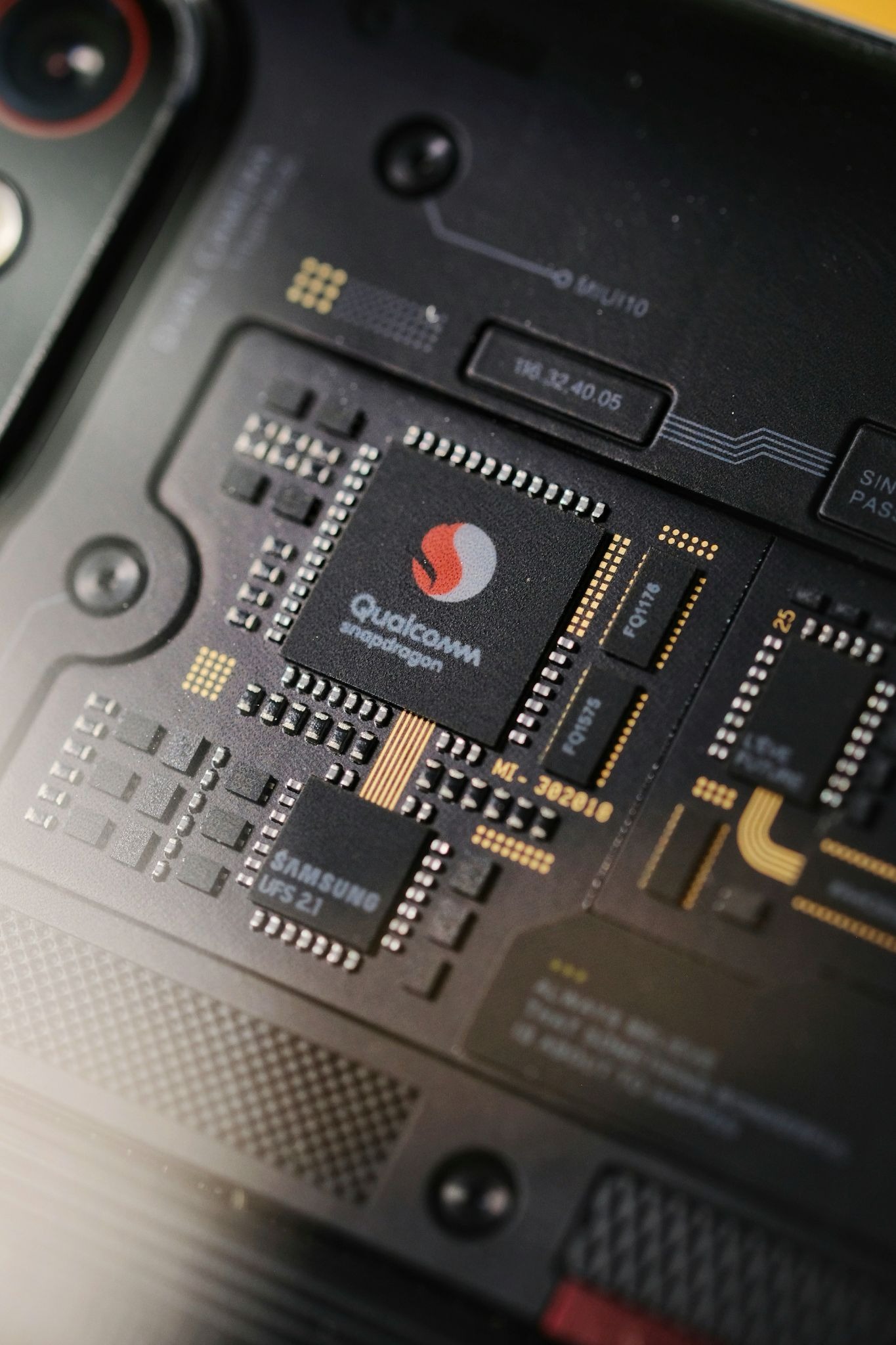
While cloud giants optimize massive data center chips and NVIDIA adapts server GPUs for smaller enclosures, Qualcomm has built a remarkably dominant position in edge acceleration from the ground up. Their advantage lies in decades of experience designing for mobile, battery-constrained, and thermally limited environments, a background that aligns natively with the physical constraints of real-time robotics.
Instead of shoehorning high-wattage desktop architectures into compact devices, Qualcomm leveraged its deep domain expertise in Digital Signal Processors (DSPs) and Hexagon[11] processing units, evolving them into highly efficient Neural Processing Units. These DSPs are integrated directly onto unified System-on-Chips (SoCs) alongside CPUs, GPUs, and advanced connectivity modules. This integrated approach minimizes off-chip memory access, drastically reducing latency and power draw, the two biggest bottlenecks in mobile robotics.
Compared to NVIDIA’s edge solutions like Jetson, which, despite their computational strength, still carry the legacy and power characteristics of discrete GPU architectures, Qualcomm's SoCs deliver superior energy efficiency per watt. Furthermore, Qualcomm’s historical leadership in integrated cellular and wireless connectivity (5G, Wi-Fi) provides a distinct edge in physical environments where heat dissipation, battery life, and compact physical footprint are strict engineering constraints.
However, Qualcomm’s most aggressive play isn't just in hardware silicon, but in breaking the developer lock-in that has long protected legacy GPU ecosystems. The acquiring of Modular[12], the creator of the Mojo programming language and MAX inference engine, signals a direct attack on hardware vendor lock-in. Mojo allows developers to write high-performance AI code that compiles across diverse architectures, CPUs, NPUs, and GPUs, without being trapped by proprietary frameworks like CUDA, and promotes this as “democratizing AI compute”. The other big acquisition by Qualcomm was Arduino last year[13], which allows Qualcomm to embrace a massive global open-source community of millions of developers and makers, bridging the gap between educational prototyping and industrial edge deployment. It’s no coincidence that Arduino’s latest board, the Arduino UNO-Q, features a Qualcomm Snapdragon chip equipped with a Hexagon DSP[14]. These two acquisitions are complementary and both are towards the same objectives, backing open-source developer ecosystems and promoting cross-platform software portability. Qualcomm is positioning itself not just as a chip vendor, but as the premier open platform for edge intelligence.
Different strategies: how to reconcile Edge and Cloud
Cloud and Edge are not always opposites; sometimes, they are complementary strategies that can be combined into one solution. In the literature, there are several architectures that combine these concepts, including cloudlets that use a cloud model, but instead of the cloud it uses a local server, securing deterministic latency and throughput. Other approaches including both Edge and Cloud are fog computing and intelligent offloading [15].
Conclusion
The evolution from cloud computing vs edge computing is not a story of one replacing the other, but of an architectural specialization driven by physical, technical, and economic realities. For robotics and autonomous systems, the physical world imposes strict boundaries: real-time execution demands sub-millisecond determinism, operational safety requires independence from network jitter, and sensitive deployments demand the reduced attack surface that only local processing can provide.
Economically, the narrative has matured as well. While cloud infrastructure offers early-stage agility, scaling real-time robotic fleets on a purely cloud-dependent OpEx model leads to volatile operational overhead. Edge computing reframes compute as a predictable CapEx asset lifecycle, where upfront hardware investments and planned maintenance deliver long-term margin control.
This divergence in requirements has reshaped the entire AI silicon landscape. Cloud hyperscalers like Google, Amazon, and Meta continue to invest heavily in proprietary cloud accelerators to lower data center costs and optimize internal server workloads. Meanwhile, the edge demands a fundamentally different engineering approach focused on energy density and thermal efficiency. While legacy giants adapt server GPUs or FPGAs for embedded platforms, Qualcomm has established itself as a major player and driving force in edge AI. By combining low-power SoC mastery, native connectivity, open-source community engagement, and cross-architecture software runtimes, they are directly tackling the energy and software challenges of local compute.
Cloud vs Edge is not an either-or situation. Each one is a clear option under certain constraints, and for real-time applications, edge is a no-brainer. But more and more strategies and patterns are being developed to use both and decide automatically, this is known as intelligent offloading and leverages the advantages of both paradigms.
Ultimately, the future of real-time robotics hinges on software liberation and hardware efficiency. As open platforms dismantle legacy CUDA vendor lock-in and deliver real-time intelligence directly on the machine, edge computing is transitioning from a specialized alternative into the definitive architectural foundation for physical AI.
References
[1] Brown, Tom, et al. "Language models are few-shot learners." Advances in neural information processing systems 33 (2020): 1877-1901. https://doi.org/10.65525/svup.9788199778009.2026.224-230
[2] Krizhevsky, A., Sutskever, I., & Hinton, G. E. (2012). Imagenet classification with deep convolutional neural networks. Advances in neural information processing systems, 25. https://doi.org/10.1145/3065386
[3] Nvidia. (2007). NVIDIA CUDA compute unified device architecture programming guide (Version 1.0). https://developer.download.nvidia.com/compute/cuda/1.0/NVIDIA_CUDA_Programming_Guide_1.0.pdf
[4] Shi, W., Cao, J., Zhang, Q., Li, Y., & Xu, L. (2016). Edge computing: Vision and challenges. IEEE internet of things journal, 3(5), 637-646. https://doi.org/10.1109/cc.2016.740572
[5] Satyanarayanan, M. (2017). The emergence of edge computing. Computer, 50(1), 30-39. https://doi.org/10.1109/mc.2017.9
[6] Nvidia. (2026). NVIDIA Jetson Thor Series (Version 1.5) https://developer.download.nvidia.com/assets/embedded/secure/jetson/thor/docs/Jetson_Thor_Series_Modules_Datasheet_DS-11945-001v1.5.pdf?t=eyJscyI6InJlZiIsImxzZCI6Imh0dHBzOi8vZ2VtaW5pLmdvb2dsZS5jb20vIn0=&__token__=exp=1785260963~hmac=e0de51dd4128bb0d271e9ccd0529c75f0b40136e2fc08589abc20fb5cae35b5c
[7] AMD (2026). Versal AI Edge Series Gen 2 and Prime Series Gen 2 Technical Reference Manual [AM026] (Version 1.4). https://docs.amd.com/r/en-US/am026-versal-ai-edge-prime-gen2-trm/Subsystems-Overview
[8] Google. TPU Architecture (2026). Available online. https://docs.cloud.google.com/tpu/docs/system-architecture-tpu-vm
[9] AllElectroHub, Adrian. Inside Amazon's AI Chip Architecture (2025). Available online.
https://www.allpcb.com/allelectrohub/inside-amazons-ai-chip-architecture
[10] Coburn, J., Tang, C., Asal, S. A., Agrawal, N., Chinta, R., Dixit, H., ... & Sourouri, M. (2025, June). Meta's Second Generation AI Chip: Model-Chip Co-Design and Productionization Experiences. In Proceedings of the 52nd Annual International Symposium on Computer Architecture (pp. 1689-1702). https://doi.org/10.1145/3695053.3731409
[11] Qualcomm. Unlocking on-device generative AI with an NPU and heterogeneous computing (2024). https://www.qualcomm.com/content/dam/qcomm-martech/dm-assets/documents/Unlocking-on-device-generative-AI-with-an-NPU-and-heterogeneous-computing.pdf
[12] WIRED. Qualcomm Buys Buzzy Chip Startup Modular for Nearly $4 Billion (2026). https://www.wired.com/story/qualcomm-buys-buzzy-chip-startup-modular-for-nearly-dollar4-billion/
[13] Forbes. Qualcomm Acquires Arduino To Advance Its Embedded Platform Strategy (2025). https://www.forbes.com/sites/moorinsights/2025/10/07/qualcomm-acquires-arduino-to-advance-its-embedded-platform-strategy/
[14] Arduino. Arduino Uno-Q Documentation. Available Online. https://docs.arduino.cc/hardware/uno-q/
[15] Kumar, A., & Pal, A. (2025). A survey on computation offloading and current trends. IEEE Access. https://doi.org/10.1109/access.2025.3625187