Time series data is definitely a term you want to get to know today. From demand planning and anomaly detection to infrastructure monitoring and financial risk modeling, temporal data is crucial for understanding how systems evolve and making informed decisions.
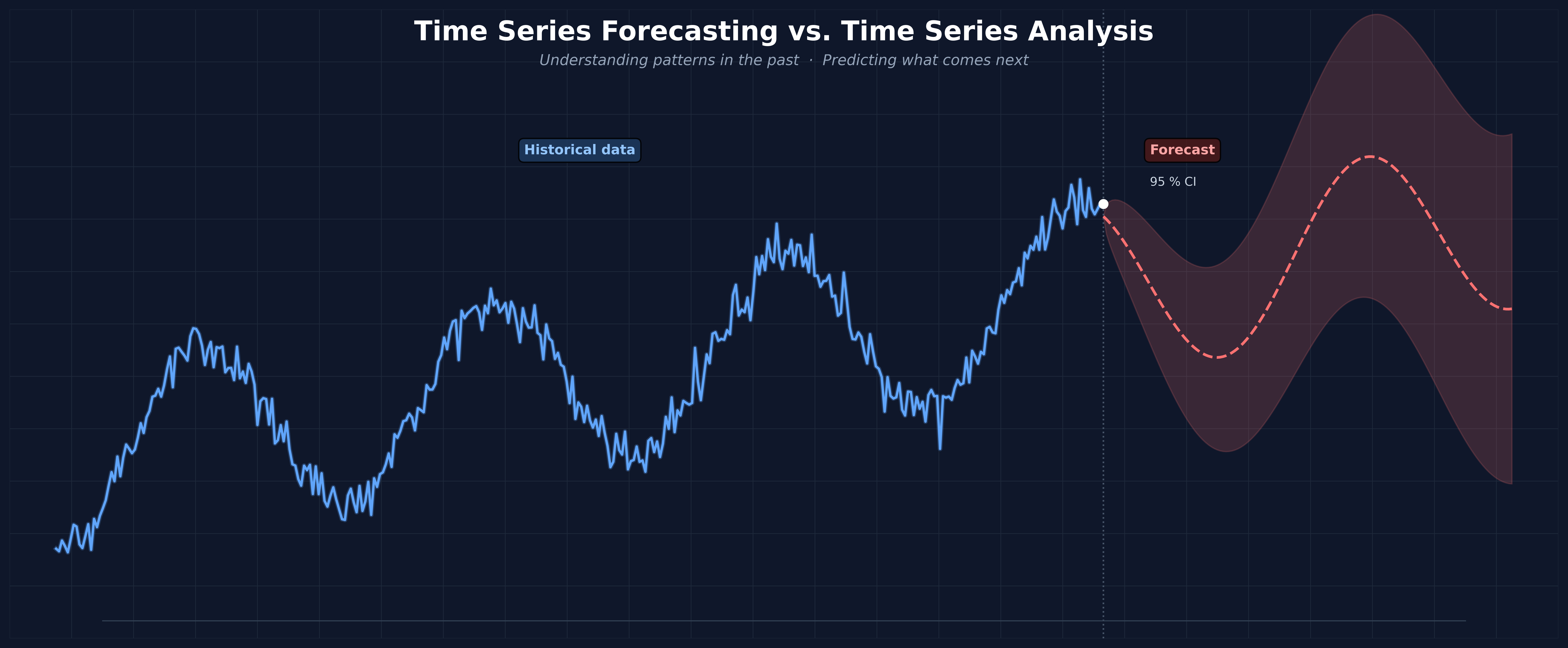
Time series analysis and time series forecasting have different purposes. Time series analysis focuses on understanding patterns and behaviors within historical data, while time series forecasting uses those patterns to estimate future outcomes. In practice, these two different approaches are complementary. While analysis clarifies the data's structure, forecasting uses this information to make predictions.
What Is Time Series Data?
Time series data consists of observations recorded sequentially over time. These observations are typically collected at regular intervals—such as seconds, days, or months—although irregular event-based data is also common in many systems.
What distinguishes this type of data is its inherent order. Each data point is not independent; previous values often influence it. This temporal dependency introduces additional complexity, but also provides valuable information that static datasets cannot capture.
One important characteristic is non-stationarity. In many real-world cases, the statistical properties of the data—such as mean and variance—change over time. Trends, seasonality, and external factors often drive these changes. As a result, transforming the data (e.g., by differencing or decomposition) is often necessary before applying analytical or forecasting models.
Time Series Analysis: Purpose and Core Techniques
Time series analysis is primarily concerned with understanding the underlying structure of temporal data. In most business scenarios, it serves as the first step before predictive modeling.
So, the first step is to visualize the data and identify patterns, e.g., revenue, traffic, and operational signals. From there, analysts evaluate whether the series is stable, whether transformations are required, and how strong seasonal or cyclical effects might be.
The main objective is to separate a meaningful signal from noise and allow teams to identify long-term trends, recurring seasonal behavior, structural changes, and unexpected deviations. While forecasts can guide operations, a clear understanding of underlying drivers is essential for strategy and long-term planning.
Key Analytical Methods
Several well-defined techniques are fundamental in time series analysis.
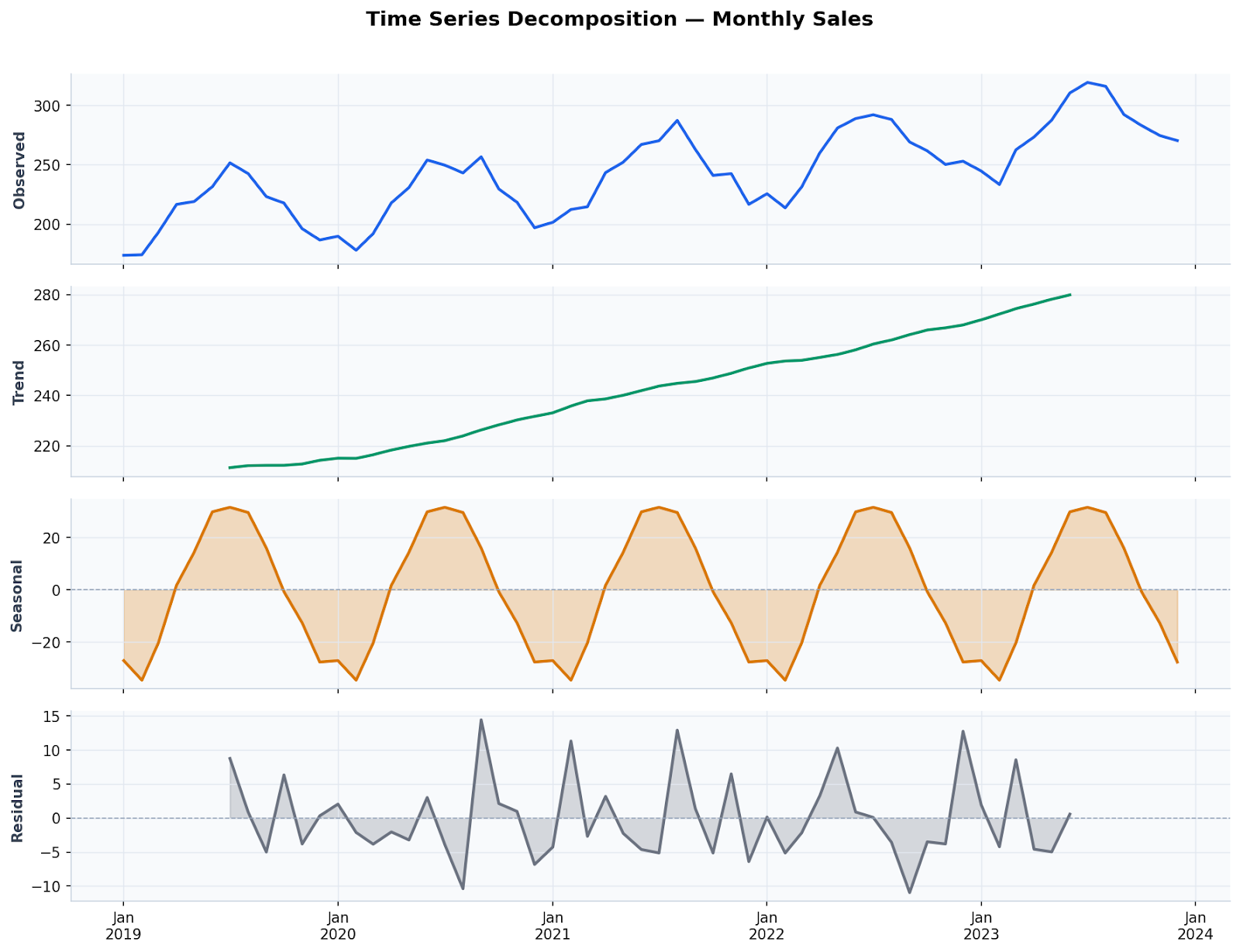
There are some decomposition methods that break a series into trend, seasonal, and residual components. This will make it easy to interpret underlying patterns. Autocorrelation and cross-correlation help quantify relationships between observations over time or across multiple variables.
In more complex scenarios, frequency-domain methods such as spectral analysis can reveal periodic patterns that are not immediately visible. At the same time, parametric models—such as those based on autoregressive structures—assume a predefined form and estimate its parameters, while non-parametric approaches focus on learning patterns directly from the data without strong assumptions.
From a practical standpoint, most analytical workflows aim to isolate systematic behavior from randomness. Once that separation is achieved, the remaining variability becomes easier to monitor and explain.
If you are using Python to analyze time series data, the Darts library is a strong option. It provides a unified framework for both analysis and forecasting, enabling practitioners to experiment with multiple approaches efficiently.
Darts includes a wide range of models, from classical statistical methods such as Naive Mean and ARIMA to more advanced machine learning and deep learning models like LightGBM, Transformers, and N-BEATS. This flexibility makes it particularly useful for benchmarking and selecting the most appropriate model for a given use case.
When Businesses Need Time Series Analysis
Time series analysis is particularly valuable when the goal is to understand why something happened.
For example, organizations may use it to explain fluctuations in quarterly sales, evaluate the impact of a marketing campaign, or detect early signs of equipment degradation. In these situations, the primary value lies in interpretation rather than prediction.
Time Series Forecasting: Models and Use Cases
Time series forecasting estimates future values based on historical observations. This is really common across industries because several operational decisions depend on accurate forward-looking estimates.
Common applications include demand forecasting, workforce planning, revenue projections, and capacity management. In these contexts, even small improvements in accuracy can translate into measurable business impact.
Forecasting works best when historical data contains consistent, repeatable patterns. When such a structure exists, models can learn from past behavior and generalize it to future scenarios.
Classic Forecasting Models
Traditional statistical models continue to play an important role in forecasting.
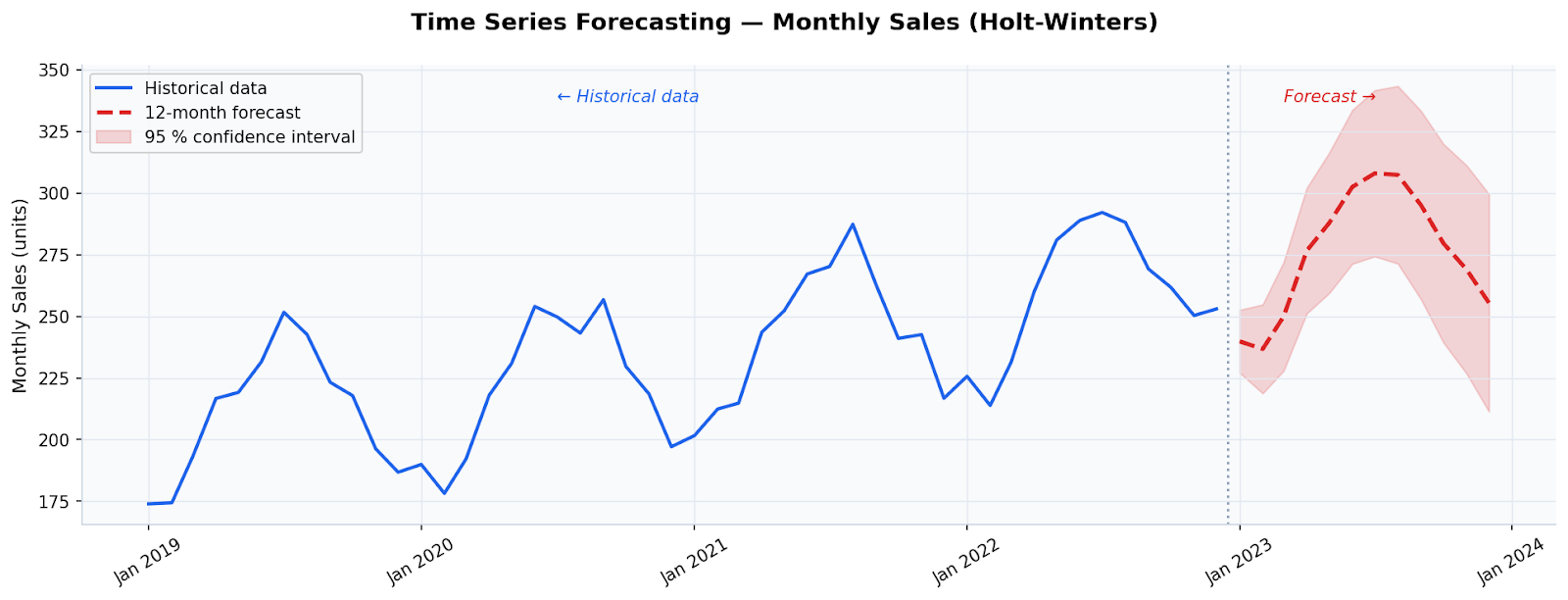
Methods such as the ARIMA and seasonal ARIMA (SARIMA) models model relationships between current and past values, while exponential smoothing techniques—such as Holt-Winters—emphasize recent observations and explicitly account for trend and seasonality.
These models remain widely used because of their interpretability. They provide clear insights into how predictions are generated, which is often important in business environments.
Machine Learning & Deep Learning Approaches
Actually, machine learning and deep learning algorithms have significantly expanded forecasting capabilities.
Modern approaches can model complex, nonlinear relationships and simultaneously incorporate multiple input variables. Architectures such as recurrent neural networks, transformer-based models, and hybrid systems are increasingly used in scenarios where we have high-dimensional data or when external factors —such as promotions, weather, or user behavior— have an impact on our predictions.
When Organizations Should Use Forecasting
Forecasting is most appropriate when decisions depend on future estimates.
Typical examples are when you have to determine inventory levels, allocate resources, plan budgets, or optimize infrastructure usage. In these cases, the ability to anticipate demand or system behavior provides a clear competitive advantage.
However, forecasting should be applied carefully. Short historical datasets, inconsistent sampling, or non-repeating events can significantly reduce reliability. Even more if you are using Deep learning approaches. In such situations, analysis may provide more value than prediction. For more on time series forecasting, check our article Time Series Forecasting: A Deep Dive into the State of the Art and Current Trends.
Analysis vs Forecasting: Key Differences
The distinction between analysis and forecasting is straightforward but important.
As we said before, analysis focuses on explaining the past behavior of our signals, while forecasting focuses on predicting future outcomes. Another key difference is that analytical work can tolerate some ambiguity, but forecasting requires greater precision. Prediction errors are more important because they can directly affect business decisions. Validating and properly evaluating are essential.
Despite these differences, the two approaches are often used together. A strong analytical foundation typically leads to more reliable forecasts.
Challenges When Working with Time Series Data
Working with time series data introduces several challenges that are less common in other types of analysis.
One of the most significant challenges in time series analysis is non-stationarity. This occurs when the statistical properties of a signal—such as its mean and variance—change over time. These variations make it more difficult to model assumptions and reduce the reliability of analytical and forecasting methods. In addition, the interaction between trend and seasonality can introduce further complexity, often making simple models insufficient.
Data quality is another important factor to be considered. If your data has missing timestamps, irregular intervals, and noisy measurements, it will reduce model performance. There are several techniques that can be used in these cases, but this depends on the nature of the problem.
Anomaly detection also presents unique difficulties. In many real-world systems, anomalies are context-dependent and may only be identifiable when considering the broader temporal pattern.
Also, overfitting remains a common risk, particularly when models become too complex relative to the available data.
How AI Enhances Time Series Analysis and Forecasting
Artificial intelligence has introduced new capabilities into time series workflows.
Machine learning models can capture nonlinear relationships that are difficult to represent with traditional statistical methods.
In addition, AI enables more advanced use cases, such as real-time anomaly detection, automated pattern recognition, and hybrid modeling that combines statistical and neural techniques.
For organizations operating at scale, these capabilities can significantly improve both decision-making speed and accuracy.
Choosing the Right Approach for Your Business
Selecting between analysis and forecasting depends on the specific business objective.
If the goal is to understand behavior, identify patterns, or diagnose issues, time series analysis is the appropriate approach. If the objective is to plan and allocate resources efficiently, forecasting becomes essential. An example for forecasting can be found on our Forecasting Electricity Consumption article.
In many cases, the most effective strategy is to combine both. Analysis provides the context needed to interpret the data, while forecasting translates that understanding into actionable insights.
Conclusion
Time series data provides a dynamic view of how systems evolve. It enables organizations to move beyond static reporting and develop a deeper understanding of their operations.
Time series analysis explains the underlying structure of that data, while forecasting turns it into a practical tool for decision-making. Together, they form a powerful framework for building data-driven strategies.
At Digital Sense, we design and deploy advanced time series solutions tailored to complex business environments. Our experience across machine learning, data science, and AI-driven systems allows us to address both analytical and predictive challenges at scale.
We have also explored these topics in depth in our articles “Detecting Anomalies in Time Series: Theory Meets Practice” and “Time Series Analysis with Databricks: A Complete Guide”, where we present practical approaches and real-world considerations for building robust time series systems.
If your organization is evaluating time series forecasting or advanced series analysis initiatives, we invite you to explore our work or connect with our team to discuss your specific needs.
References
- Time Series Data Analysis
- Time Series Analysis: Definition, Types, Techniques, and When It's Used
- AWS: Understanding time-series data and why it matters
- What Is a Time Series and How Is It Used?
- What are ARIMA models?
- DARTs
- Detecting Anomalies in Time Series: Theory Meets Practice
- Time Series Analysis with Databricks: A Complete Guide


.jpg)